
A practical guide to UL746C f1, UV stability, and what really determines how long a plastic enclosure survives outdoors.
The problem nobody specifies for
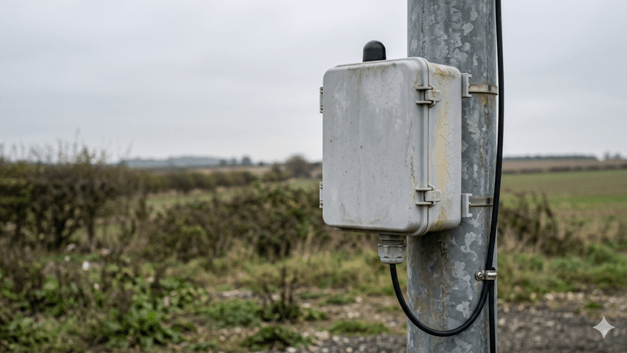
A few years into any large outdoor IoT deployment, a pattern starts to emerge. The enclosures that looked identical on the procurement spreadsheet no longer look identical in the field. Some are intact. Others have gone chalky and pale. A few have hairline cracks around the mounting points. One or two have started letting moisture in around the gasket not because the seal has failed, but because the plastic the seal sits in has deformed.
None of these enclosures has lost its IP66 rating in any meaningful sense. They were all tested to IP66 on the day they shipped. The test is not the problem. The assumption that the test predicts long-term outdoor performance is the problem.
This is the gap that catches out engineers specifying enclosures for the first time for genuinely outdoor applications smart agriculture, EV charging telemetry, environmental monitoring, smart-city sensing, renewables, edge gateways on poles and rooftops. The IP rating answers a question. It’s just not the question that matters most over a five-year deployment.
The question that matters is: what does the plastic itself do when it lives outside?
The answer is governed by a different standard, and a single letter-number combination on a datasheet tells you whether the enclosure was engineered to give a useful answer or a hopeful one. That combination is UL746C f1.
What IP66 actually tests, and what it doesn’t
IP ratings are defined by IEC 60529. The two digits describe protection against solids and liquids respectively. IP66 means total protection against dust ingress, and protection against powerful water jets from any direction.
It is a useful, well-defined, repeatable test. The problem is what’s outside its scope.
IP testing is conducted on an enclosure in known good condition. It tells you nothing about:
- How the plastic behaves after 8,000 hours of direct sunlight
- Whether the material retains its impact strength after repeated freeze-thaw cycles
- Whether the gasket seat remains dimensionally stable as the housing slowly warps
- Whether the material’s dielectric properties hold up when wet
- What happens to surface integrity after years of UV-driven photo-oxidation
In other words: IP66 is a snapshot. Outdoor IoT deployments are a film.
A polycarbonate enclosure that passes IP66 brilliantly on day one can be a brittle, chalking, micro-cracked liability by year three if the base material wasn’t formulated and tested for outdoor exposure. And once the material has degraded, the IP rating is academic water doesn’t need the gasket to fail if it can find a crack in the housing itself.
What sunlight actually does to plastic
The mechanism is photo-oxidation. UV radiation specifically the UV-B and shorter UV-A wavelengths has enough energy to break the chemical bonds in many polymers. When those bonds break, free radicals form. In the presence of oxygen (i.e. always, outdoors), those radicals trigger a cascade of oxidation reactions that progressively change the material’s properties.
Visible symptoms, in roughly the order they appear:
- Yellowing or colour shift. Cosmetic at first, but a useful early warning that photo-oxidation is underway.
- Surface chalking. A powdery white deposit on the surface, particularly on darker colours. It’s degraded polymer and released pigment.
- Loss of gloss. The surface roughens at a microscopic level.
- Micro-cracking, especially at stress points. Around mounting holes, cable entries, corners.
- Embrittlement. Impact strength drops. A unit that would shrug off a knock in year one will crack in year four.
- Dimensional change. Slow but real, particularly under combined UV and thermal cycling.
- Eventual mechanical or sealing failure.
Standard, non-UV-stabilised polycarbonate begins showing meaningful surface degradation within 12–24 months of full outdoor exposure in temperate climates, faster in high-UV regions. ABS is worse. Many generic outdoor enclosures on the market use these base materials with no UV stabilisation package and no UL746C testing to back them up.
UV-stabilised grades, polycarbonate with HALS (hindered amine light stabilisers) and UV absorbers compounded in, perform dramatically better. But “UV-stabilised” is an unregulated claim. Anyone can write it on a datasheet. The standard that turns the claim into a verified rating is UL746C.
What UL746C actually is
UL746C is the standard published by UL Solutions covering polymeric materials used in outdoor enclosures of electrical equipment. It’s not the only outdoor-plastics standard in the world, but it’s the one most widely cited on enclosure datasheets sold into the UK, EU and US markets, and it’s a genuinely rigorous test.
The standard subjects materials to extended UV exposure (typically via xenon-arc weatherometer, which simulates sunlight), water exposure, and thermal cycling, and then measures whether the material’s key properties survive. Properties tested include:
- Tensile strength
- Impact strength
- Dielectric strength
- Flammability rating retention (the UL94 rating shouldn’t drop after weathering)
A material passes UL746C only if it retains a specified percentage of its original performance across these properties after the exposure regime. It’s a pass/fail standard with two tiers of pass, and those tiers are the bit engineers most often miss.
f1 versus f2 – and why the difference matters
UL746C awards one of two performance levels:
- f1 – suitable for outdoor use, with or without exposure to water and UV.
- f2 – suitable for outdoor use only when sheltered from direct UV and water.
The distinction is enormous. An f2-rated material can legitimately be called “outdoor rated” on a datasheet. It just won’t survive the kind of outdoor that involves direct sunlight and rain – which, in any honest reading, is what “outdoor” means.
If you’re specifying for a pole-mounted sensor node, a rooftop gateway, an agricultural device, a roadside cabinet, or anything else that lives in the open air, f2 is not good enough. You need f1.
The trap is that an enclosure datasheet may quote “UL746C rated” without specifying the tier. Sometimes this is because the manufacturer doesn’t know. Sometimes it’s because the answer is f2 and they’d rather you didn’t ask. Either way, the answer is worth knowing before the purchase order goes out, not after the third year of deployment.
What this means in practice – a specifier’s checklist
When evaluating an enclosure for outdoor IoT use, the IP rating is necessary but not sufficient. A more complete shortlist of questions:
Sealing
- What’s the IP rating? (For most outdoor IoT, IP66 minimum, IP67 if water immersion is plausible.)
- How is the gasket retained – moulded-in, glued, or seated in a profile? Profile gaskets generally outlast adhered ones.
- What gasket material? Silicone outlives EPDM outlives standard rubber under UV.
Material
- What’s the base plastic? (Polycarbonate is generally better than ABS for outdoor longevity.)
- What’s the UL94 flammability rating? (V-0 is the standard expectation for industrial deployments.)
- Is the material UL746C rated, and is it f1 or f2? If it’s not f1, it’s not genuinely outdoor.
- What’s the operating temperature range, and is that range continuous or short-term?
Mechanical
- What impact rating, if any, is claimed (IK rating)?
- How are PCBs mounted internally – to the housing or to a separate sub-plate? Sub-plates tolerate housing deformation better.
- How is the lid retained, and how does retention degrade under repeated thermal cycling?
Supply
- Where is it manufactured, and what’s the realistic lead time for replenishment?
- Can it be customised – machining, printing, custom cut-outs and if so, at what minimum order quantity?
If any of these answers comes back vague, that’s a signal in itself.
The Suffolk answer
The Camdenboss Nodes & Hubs range was specified explicitly for the deployments where these questions matter – outdoor IoT, smart sensing, edge computing in environments that don’t read the datasheet.
The full specification:
- IP66 sealing across the range, with sealed outer-profile gasket and internal fixing posts
- UL94 V-0 polycarbonate for flammability
- UL746C f1 UV stability – the higher tier, suitable for unsheltered outdoor use
- Wall, pole, and DIN-rail mounting with concealed or flanged finishes
- Operating range engineered for extreme temperatures and UV exposure
- Designed, CNC-machined, digitally printed and assembled in Suffolk, under one roof – meaning custom cut-outs, branding, and labelling can be turned around in days rather than weeks, and supply isn’t dependent on European import lead times
That last point is increasingly load-bearing. UK and European engineers specifying for production deployments are no longer indifferent to where an enclosure is made. Single-roof UK manufacturing means a known lead time, a customisation path that doesn’t require a separate vendor, and a supply chain that doesn’t break when a ferry is delayed.
The summary, for the engineer in a hurry
If you only remember three things from this article:
- IP66 is a snapshot test. It tells you the enclosure was sealed on the day it shipped. It tells you very little about year three.
- UL746C f1 is the spec line that matters for outdoor longevity. It’s the rating that tells you the plastic itself was engineered and verified to survive UV, water and thermal cycling. f2 is not the same thing.
- Ask the awkward questions before you specify, not after. Material, rating tier, gasket retention, mounting flexibility, manufacturing location and lead time. If any answer is vague, find another supplier.
Specifying an outdoor enclosure for an IoT, sensing, or edge application? The full Camdenboss Nodes & Hubs range IP66, UL94 V-0, UL746C f1, engineered and manufactured in Suffolk is at marketing.camdenboss.com/nodes-hubs. Or reply with the awkward spec question our technical team would rather answer it now than have you discover the answer in year three.